

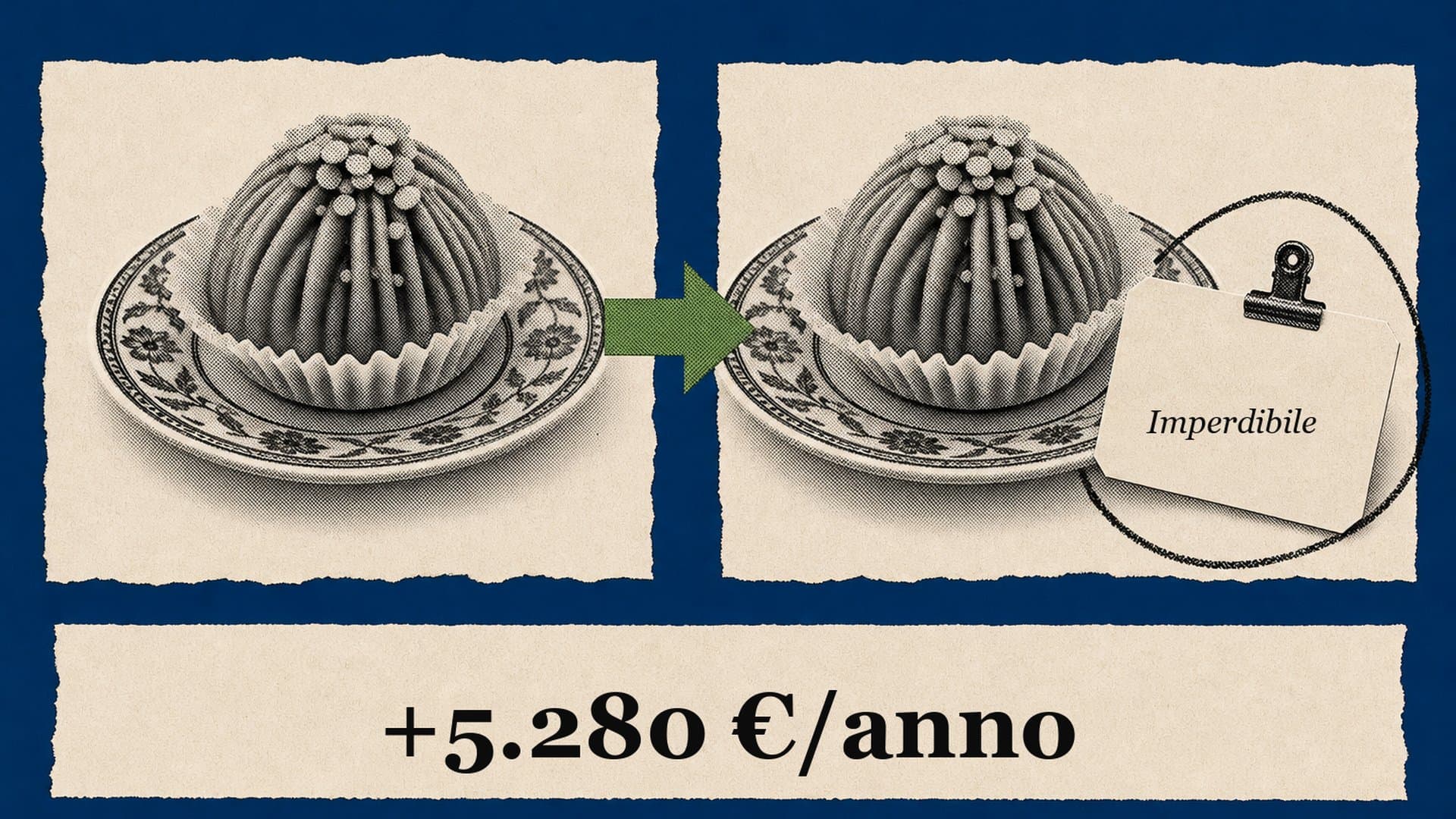
€5,280 a year in net margin. Cost of the intervention: three paper signs. Advertising spend: zero.
This is the true story of La Medina, a tearoom near the Arco della Pace in Milan. It is also a way to explain a principle that applies far beyond pastry shops: the marketing that genuinely changes a small or medium-sized business is not the marketing that spends money; it is the marketing that permanently changes a fundamental business metric.
If you are looking for another article about “AI growth hacking”, you are in the wrong place. If you have a viable business that is not scaling as you would like — and you are tired of spending €2,000 a month on advertising without seeing another customer — stay.
Table of contents
- The case before the principles
- What we did: three small signs
- The result, calculated by hand
- What we did not do
- Why it works: leverage versus injection
- What to look for in your business: three questions
- How the same principle applies to other businesses
- The trap that catches almost everyone
- Three rules to take away
- How we apply this at Futuria
The case before the principles
Several years ago, we worked with La Medina, a tearoom and pastry shop overlooking the Arco della Pace in Milan. It opens seven days a week. Its pastries are handmade and some require up to three days of preparation. You walk in, choose at the counter, pay and eat.
The problem was not quality — the quality was exceptional — and that was precisely what made it paradoxically invisible. When all your pastries are excellent, they appear all the same to a customer. The display is flat: ten portions in a row, ten names quietly mentioned, nothing drawing the customer’s eye towards one rather than another. The customer chooses the first on the left, the most colourful, or the one the person ahead just ordered. What they almost never choose is the pastry that leaves the baker the highest margin.
We started with the numbers. For each pastry we calculated two figures: sale price and true cost, including ingredients, labour per portion and equipment depreciation. The difference is the margin. Everyone should do that calculation before putting a product on a menu, yet surprisingly few do because nobody has ever told them to.
The result was that three pastries out of roughly ten produced about 40 cents more margin than the others. They did not cost the customer more — prices were aligned — but their production cost was lower at the same sale price. They were the shop’s most profitable pastries, and nobody knew it: not the customer and often not even the staff at the counter.
What we did: three small signs
We wrote three signs, one for each of those pastries. They did not describe ingredients. They described an experience and spoke to three different customers who can easily stand within the same square metre of marble in a Milan pastry shop at 4:30 in the afternoon:
- The taste of childhood. For someone looking for a memory.
- Absolutely unmissable. For someone seeking the house speciality.
- The most diet-friendly choice. For someone already holding a pastry and feeling guilty.
No new products. No new prices. No rearranged display. No photographer, new website or social campaign. We simply placed a story beside three of the ten pastries, giving the customer’s eyes somewhere to stop and their mind a reason to choose.
The result, calculated by hand
Customers stopped at those signs. They read them. They chose the three higher-margin pastries more often than before. Not every time — that would have been suspicious — but more often.
On average, the shop sold 40 additional portions per day of the three higher-margin pastries instead of alternatives.
- 40 portions × €0.40 additional margin per portion = €16 more per day.
- €16 × 330 opening days — the shop opens seven days a week, excluding holidays — = €5,280 more per year.
This is not a dramatic reveal. It is not €50,000 and it will not make the article go viral on LinkedIn. It is €5,280 every year, from then onwards, for as long as the small stories remain on the counter. It can be the difference between paying the gas bill on time or late. Over ten years, it becomes €52,800 — more than a year’s salary for the full-time member of staff who helps sell those higher-margin pastries. All because three pieces of paper were written properly.
What we did not do
This needs to be stated honestly, because it is the real point:
- We did not launch a Google Ads campaign.
- We did not film a “behind the scenes at a Milan pastry shop” Reel.
- We did not rebuild the website.
- We did not create a TikTok account.
- We did not even change the typeface on the price labels.
Any agency selling hours and media might have recommended some combination of those activities to La Medina. They would have been more expensive, slower, more reversible and probably less effective.
A well-run campaign in Milan can easily require €2,000 per month in advertising spend before management fees. Over 12 months, that is €24,000 spent to bring in new customers who encounter the same flat counter and still choose the first pastry on the left.
Why it works: leverage versus injection
Take this idea away from the article. It is the real lesson.
There are two ways to move a business metric: an injection and a lever.
An injection is advertising spend, a campaign, a launch discount or a sponsored post. It works while you pay. When you stop paying, the effect runs out — usually faster than expected. It is useful at certain moments, such as a launch, promotion or new city, but it is temporary by definition.
A lever is a smaller, cheaper and permanent intervention. Once installed, it works for you every day without constant attention. A sign on a counter is a lever. A well-written e-commerce checkout upsell is a lever. An automated email sent five days after a purchase is a lever. Rewriting a service page so visitors understand what you sell within eight seconds is a lever.
The practical difference:
| Injection | Lever |
|---|---|
| Costs money every month | Costs once |
| Stops when you stop paying | Keeps working for years |
| Moves the metric for the duration of the campaign | Moves the metric permanently |
| Produces immediately visible results | Reaches steady-state more slowly, but accumulates |
| Works best when sound levers are already in place | Works even better when injections are added later |
They are not enemies. They are different tools. The problem is the order in which they are used. Most Italian SMEs try injections first because they are visible and feel like “doing marketing”. They get burned and conclude that marketing does not work. In reality, the problem is not marketing; they tried the medicine before building the infrastructure on which it acts.
What to look for in your business: three questions
If this way of thinking interests you, start with three questions. They are easy to read, but writing the answers may take an afternoon. It is worth it.
1. Which fundamental metric, if it moved by 5%, would change my margins for the next three years?
Not the metric you think you should move — the one that genuinely weighs on the business. For one company it is website conversion rate. For another it is average transaction value, purchase frequency, the duration of the customer relationship or acquisition cost. I suspect that, for most SMEs, at least one of the first four is more movable than acquisition cost.
Choose one, not a list of eight. If you cannot choose one, you probably do not yet have enough data to think structurally. That becomes the most urgent intervention: put the basic business figures into a spreadsheet.
2. What is the smallest, cheapest and most permanent intervention that could move it?
“Small” matters. A small intervention can be done now. It does not require a three-year plan or get postponed until next quarter. Three signs can be written in an afternoon. A checkout upsell can be added in a morning. A service page can be rewritten in a week.
“Permanent” matters too. If the intervention stops working when you stop maintaining it, it is an injection, not a lever.
3. Am I changing the product or service, or communicating it better?
In 90% of established SMEs, the product is already good. If it were not, the business would probably no longer be open. The problem is communication, not production. Communication gives you more leverage, costs less and changes indicators faster. Start there.
How the same principle applies to other businesses
The intervention took the form of counter signs because La Medina sells pastries over a counter. The principle translates. For example:
E-commerce. Revenue does not have to grow through more traffic; increase average order value. A well-written checkout upsell — “Add our X for €4; 60% of customers choose it” — can move the average basket by 5–15% without changing traffic. An automated email five days after purchase, offering a relevant complementary product, increases purchase frequency. Recurring cost: zero once it has been written properly.
Professional practice. Revenue does not have to grow through new clients; increase the value of existing clients. Give every new client a short guide called “Three things people forget to ask us, but should”. Send an automatic follow-up after the final invoice asking whether there is anything else you can handle. Send a year-end email summarising the work and proposing one concrete next step. Recurring cost: zero.
Restaurant. Do not necessarily increase covers; increase margin per cover. Review the menu, identify the dishes with genuinely high margins and make them more visible through richer descriptions or prominent placement. Treat a tasting menu as a pure lever: customers who choose it spend more and are often happier.
Marketing agency — our case. We do not necessarily increase the number of customers; we increase value per customer. A quarterly operational follow-up map can reveal additional work. A clear sheet showing four other services we could provide — not as a pitch, but as a map of possibilities — helps customers understand the wider relationship. An internal customer newsletter can show what we are doing for other clients, focusing on the operational change rather than self-congratulation. Again, the only cost is the initial writing.
In each case, a “small-sign” intervention — inexpensive, permanent and focused — will often beat a “campaign” intervention that is expensive, temporary and diffuse. Not always, but more often than you might think when the numbers are assessed honestly.
The trap that catches almost everyone
We see this pattern so often among SMEs that it is worth setting it out as a short script. If you recognise yourself, you are not alone; it is almost the rule.
- The SME feels it “needs more revenue”, usually because a cost has risen or a competitor has moved.
- It looks for an agency to “promote the business”.
- The agency proposes an advertising budget on Meta or Google. That is often what the customer expected to hear, so everyone is pleased.
- The budget runs and the figures rise for a few weeks or months.
- The budget ends and the figures return to where they started.
- The SME concludes that “marketing does not work for us” — or worse, that it works only while you pay.
In that sequence, marketing really is not working. The injection works only while it continues. The business levers have not moved by a millimetre. When the injection stops, the business is exactly where it started, minus the budget it spent.
The remedy is to install the levers before applying the injection: one at a time, small, permanent and measured.
Three rules to take away
If only these three sentences survive, that is enough.
- The fundamental metric, not revenue. Do not ask how to make more revenue. Ask which single fundamental metric you are trying to move, and why that one rather than another.
- Lever, not injection. Before allocating advertising budget, build small, inexpensive and permanent interventions that move the metric even when you stop paying. Advertising amplifies systems that already work; it does not replace them.
- Communication, not production. Nine times out of ten, the problem in an established SME is not the product but how it is explained. Work there first, because that is where you have more leverage for less effort.
How we apply this at Futuria
Our work with customers follows roughly this sequence. First, we identify the fundamental metrics of the business — the real ones, not necessarily the ones initially assumed; the list often changes after two calls. Then we test the smallest interventions that move those metrics permanently. Only afterwards, where appropriate, do we add advertising budget to things that already work independently. Budget amplifies levers; it does not compensate for their absence. Without levers, budget is simply rent paid to Meta or Google every month.
If you recognise the anti-pattern above and want to discuss the metrics in your business, contact us. No pitch and no pre-made plan — just a practical half-hour conversation in which we look together for the real lever.
Before closing, take time to write down one question, even if only on a sheet of paper for yourself: which fundamental metric in your business would change your pace if you knew how to move it by 5%? If you can name it, you are already ahead of most competitors.
If you cannot name it yet, that is not a problem. It is simply the first piece of work.
Mind the counter.