

Table of contents
- Businesses meeting people
- You understand its value only when you lose it
- Are my company and I merely guinea pigs?
- The role of events in customer acquisition
- Building a sound process
- The three stages of customer acquisition
- The event that solves all three
Businesses meeting people
Do you remember the floods of tears when, as teenagers, a boyfriend or girlfriend suddenly left us?
It felt like unparalleled despair: reality thrown into our faces, forcing us for the first time to take stock of our behaviour and of what genuinely mattered.
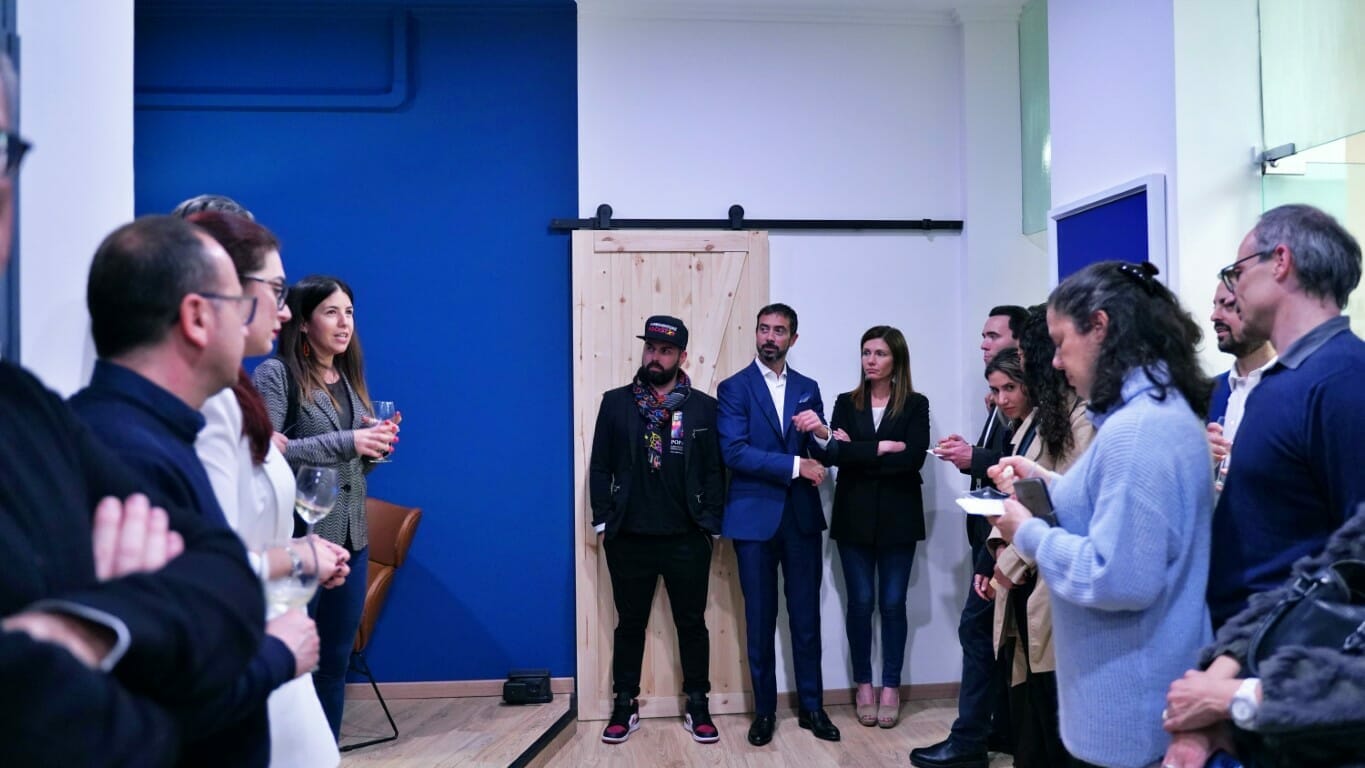
The opening of Planet, our office in central Milan — also a first-hand example of an event.
You understand its value only when you lose it
As our mothers used to say, “you never know the true value of something until you lose it”. Mothers are always right. Sometimes they take a very long route, but eventually they come back to the point.
And recently we did lose quite a few things and live through restrictions which, necessary though they were, changed our routines.
Going out, meeting, doing business, building relationships — and shaking hands.
When live activities finally resumed, two phrases appeared constantly: “It is so good to be together again” and “It is a pleasure to finally meet you in person”.
That was joyful for our lives, but it should also ring loudly in the ears of every entrepreneur. It reminds us — if any reminder were needed — that human, in-person relationships remain essential even in an increasingly digital world.
The growing speed of communication often comes at the expense of expression. Shorter messages mean more messages, but less articulation.
It is no accident that we increasingly say, “I will call you — it will be quicker” or “Let us meet in person so we understand one another”.
How can that be? Is it not a contradiction to choose something slower and more complex in order to save time? It sounds paradoxical, but it is not.
When we say “quicker”, what actually drives us is the fear of not being understood fully — of failing to communicate the deeper meaning and therefore failing in the attempt itself.
That possibility worries us in every part of life. It becomes a genuine business problem when the issue at stake is not organising dinner with a partner, but our company’s sales performance.
Here is another apparent paradox. We know digital technology is crucial to company growth, and almost every success story we hear seems to involve it. How does that fit with everything said so far?
Very simply: digital is never the objective. It is a means.
A good digital strategy does not finish the job. It feeds and expands the activities we later perform in person, with real people.
Are my company and I merely guinea pigs?
This may sound like sociology, but it is far more concrete than it appears. Consider a few examples.
Disney, a film and entertainment company — an intangible business by definition — was founded in 1923. One world war later, in 1955, it opened its first theme park near Los Angeles with Walt Disney himself in attendance.
LEGO, a maker of toy bricks — a mass-distribution product by definition — was founded in 1932 and opened the first Legoland park in 1968.
Now consider the motor industry. For decades, car manufacturers used intangible communication and marketing — newspapers, websites, advertising and television — while the sale itself remained physical through dealerships.
Then Tesla arrived. It makes cars and could have opened its own dealerships or simply supplied existing ones. Instead, it did the opposite: it digitised the sale through e-commerce and made communication and marketing physical through Elon Musk’s launch events, showrooms and the test-drive events it continually runs around the world.
Did that event-led strategy produce results? It certainly seemed so. At the time this article was written, Tesla had recently celebrated ten years as a listed company. Its shares had launched at $17 and were then trading at around $1,100. The Italian newspaper Repubblica ran the headline: “Tesla overtakes Toyota. It is the world’s most valuable carmaker”.
Even more interesting was the evolution of the market’s response.
While future Tesla customers became excited about what was coming, traditional salespeople — the “experts” — laughed: “That is not how you sell cars.”
After mockery came dismissal: “Those are not proper cars.”
Then they began spending their days chasing Tesla, trying to predict its next move. A close friend from my university years in Los Angeles now leads strategic research for the marketing department of one of Germany’s best-known car manufacturers.
In other words, he spends his days trying to understand what competitors in the same segment will do. When I visited him in Munich, he told me — verbatim:
“Fabri, we have a reasonable idea of what Audi, Porsche, Jaguar and the others will do. With Tesla, we are always waiting. For all we know, those bastards might put a dragon in the boot. They are that unpredictable.”
Now rewind and bring the lesson down to the level of Italian small and medium-sized businesses. How can these global examples help our companies and our revenue?
We will not be mocked by the world’s largest brands, but we should not expect to go unnoticed. Even at a smaller scale, doing something slightly different will look unconventional. Customers who benefit will be eager for the novelty, while competitors who feel threatened will call us mad — or at least pretend that we are.
We should not care in the slightest.
Our job is to ask how we can get dragons out of our own boots.
The role of events in customer acquisition
Building a sound process
At my marketing agency, we place enormous value on well-structured processes. They are the only defence against chaos, wasted time and avoidable mistakes.
When a new customer starts a programme with us — we deliberately call it a programme — they follow a sequence of stages whose organisation condenses years of experience and anticipates problems or needs that may arise later.
One obstacle companies often encounter is the call to action.
To explain it, let us step back and look at the three stages of customer acquisition.
Pay attention here. Whoever you are and whatever you do, every effort to achieve an objective passes through these same three stages, without exception — in private life as much as in professional life.
We all manage them unconsciously. Understanding them allows us to control them and materially influence our chances of reaching the objective.
The three stages of customer acquisition
The first stage is discovery. We address a broad audience that we have identified in advance. Those people do not know that we exist or that they might need us. Our task is to overcome that first obstacle: help them discover us and form at least a rough idea of what we do.
The second stage is trust. Discovery has earned a fragile degree of attention. People are beginning to think, “Perhaps this is relevant to me.” They now ask whether they can trust us and whether it is worth continuing to listen.
This stage lays the foundation for the relationship that may follow. We must do two things: increase the perceived value of what we offer and reduce the perceived risk of dealing with us.
Those two elements determine every choice we make. We continually ask: is this worth it, and what do I risk by continuing?
The third stage is conversion. If we have made it through the first two, people finally say: “I am interested, I feel I can trust this business, and I would like to proceed.”
Companies often focus too heavily on the first two stages — and frequently on the first one alone. Think of all the times marketing is confused with visibility. Visibility matters because everything starts there, but it is only one small part of the process.
In the third stage, the structure of the offer is what matters. Even people who responded strongly during discovery and trust may still be afraid to commit to something that feels too risky or demanding.
Be careful: if your only offer requires a large commitment and you still think, “If they are genuinely interested, they will buy it”, you are setting yourself up to fail. More and more people will hesitate.
Even when you make sales, you may be losing a much larger group: the people who wanted to take one more step but were not ready for that level of commitment.
The event that solves all three
We therefore need an intermediate step for customers and prospects: something that encourages them to move forward while giving us a strong chance of success when it is time for the real sale.
You have probably connected the dots already.
Which of the three stages does an event solve?
Spoiler: all three.
However small it may be, an event is one of the few tools capable of addressing all three problems.
First, you promote the event and people talk about it. The event itself becomes an opportunity for discovery.
Its subject automatically pre-qualifies the people who attend. If they have no interest in the topic, they simply will not come.
Once they are there, they see you at the centre of attention. They gain tangible evidence of your expertise and enough time to hear your story in detail.
You become more solid and credible in their eyes. Trust grows because an asymmetric relationship forms: you are the expert, the competent person and, unlike anonymous competitors, someone they now know.
Someone familiar is less likely to be perceived as a fraud and more likely to be chosen over an unknown competitor.
Finally, the event itself is already the softer micro-conversion we needed — the first low-risk step for people who may be willing to buy but are not yet fully convinced.
This article originally appeared in Collection Magazine by Imprenditore Rockstar, under the title “The Dragon in the Boot”, written by Fabrizio Romano for the Sold Out section.