

Table of contents
- What are documents and contracts?
- Key benefits of documents and contracts
- Overview of the documents and contracts dashboard
- Accessing the dashboard
- Date filter
- Document statuses and dashboard columns
- Creating new documents
- The document editor toolbar
- Add elements
- Page management
- Document variables
- Content library
- Recipients
- Payment settings
- Edit the email and choose a template
- Document settings
- The actions menu inside the editor
- Sending options
- Frequently asked questions
What are documents and contracts?
The Documents and contracts feature in Futuria CRM lets you create, send and track professional contracts, proposals and estimates directly inside your CRM. With templates, PDF uploads, electronic signatures, payments and automations, this feature centralises the management of your documents, improving both professionalism and efficiency.
Documents and contracts is a tool built into the Payments section of Futuria CRM that allows businesses to manage legally binding agreements. You can start from a blank document, upload an existing PDF or use a predefined template. It also supports electronic signatures, payment collection, automatic triggers and full tracking.
This feature is designed to help businesses and service providers simplify client agreements, remove paperwork and close deals faster.
Key benefits of documents and contracts
- Centralised dashboard: manage all your contracts and proposals in one organised place under Payments. This cuts the time lost searching across different tools and makes sure your team always knows the status of every document.
- Custom templates: reuse predefined templates for recurring agreements such as service contracts or proposals. This speeds up document creation while guaranteeing consistency and professionalism with every client.
- Electronic signatures with an audit trail: collect legally binding signatures online, with a certificate that records the signer's details, IP address and date and time. This provides legal protection while keeping the signing process simple for clients.
- Integrated payments: add one-off or recurring payments directly into your contracts. This lets you close agreements and get paid immediately, with no need for a separate invoicing process.
- Workflow automation: trigger actions when a document is created, sent, viewed or signed. This keeps deals moving automatically, reducing manual follow-ups and improving conversion rates.
Overview of the documents and contracts dashboard
The dashboard gives you an overview of all your contracts, estimates and proposals. This is your control centre for managing agreements.
Accessing the dashboard
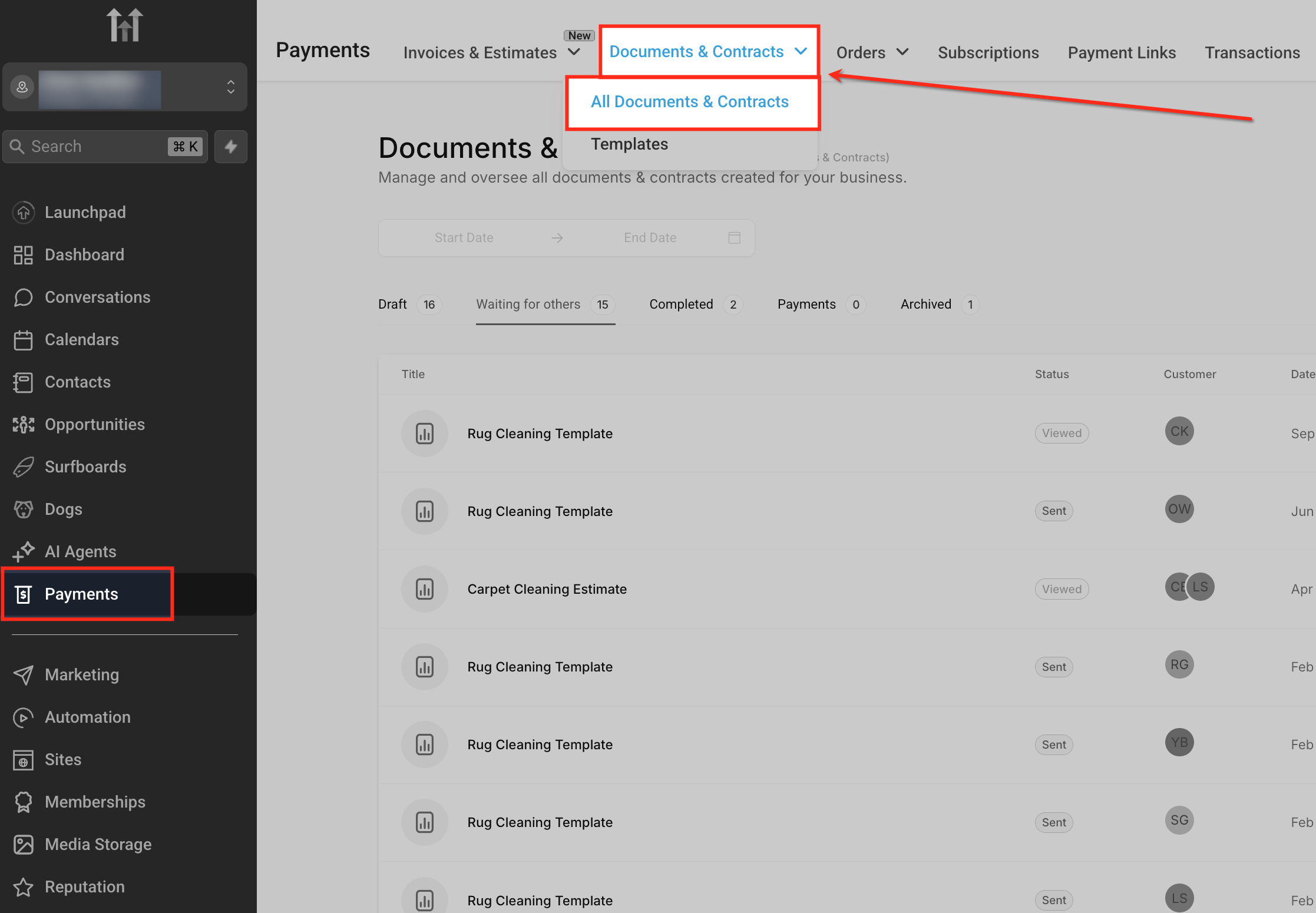
To manage all your agreements, go to Payments → Documents and contracts from the left-hand menu. From the drop-down menu, select All documents and contracts to view every draft, sent, completed or archived document in one place.
Date filter
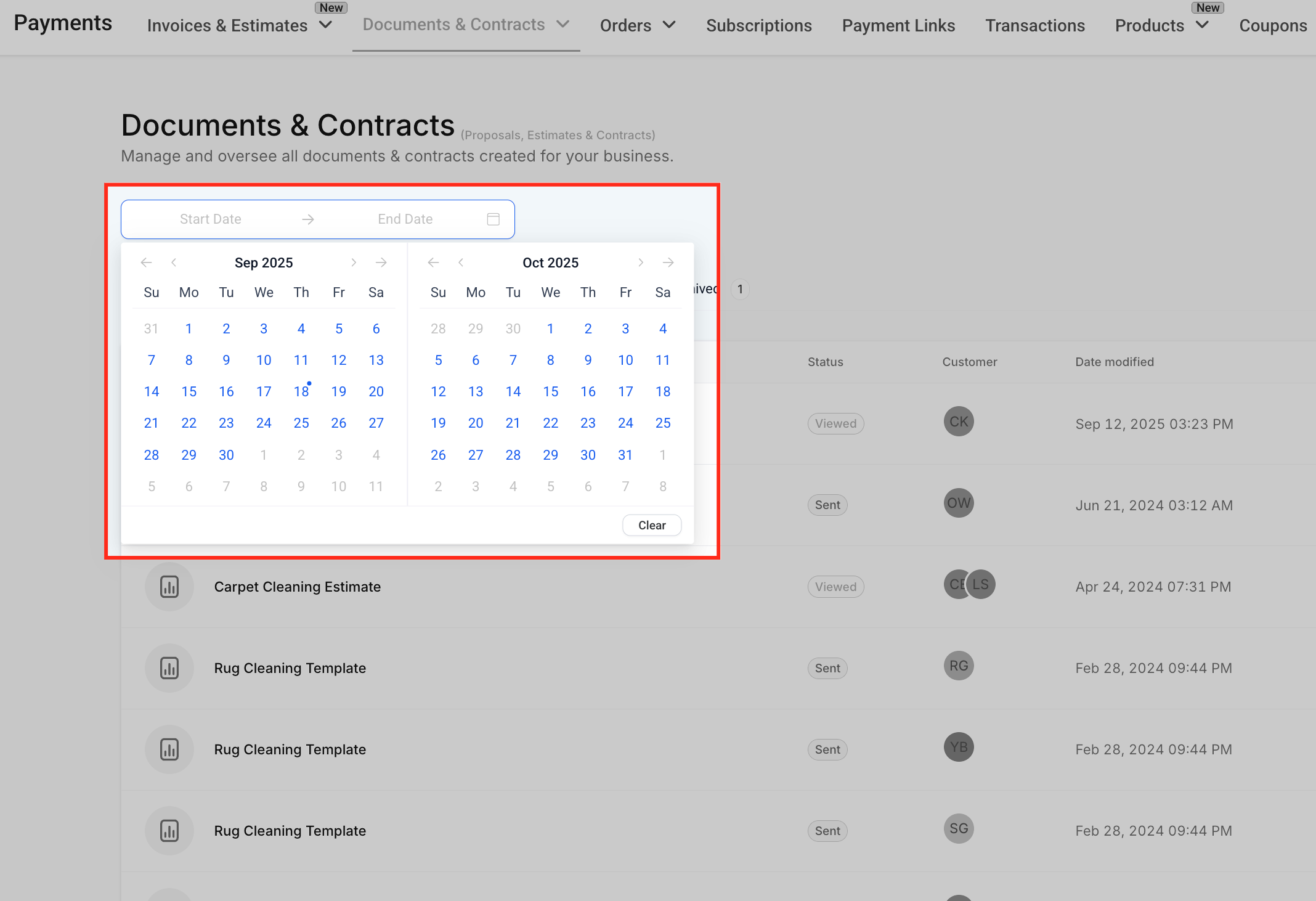
You can narrow down the results by selecting a start and end date from the calendar. This is especially useful for tracking contracts created during a specific billing cycle or for reviewing proposals sent in a given period.
Document statuses and dashboard columns
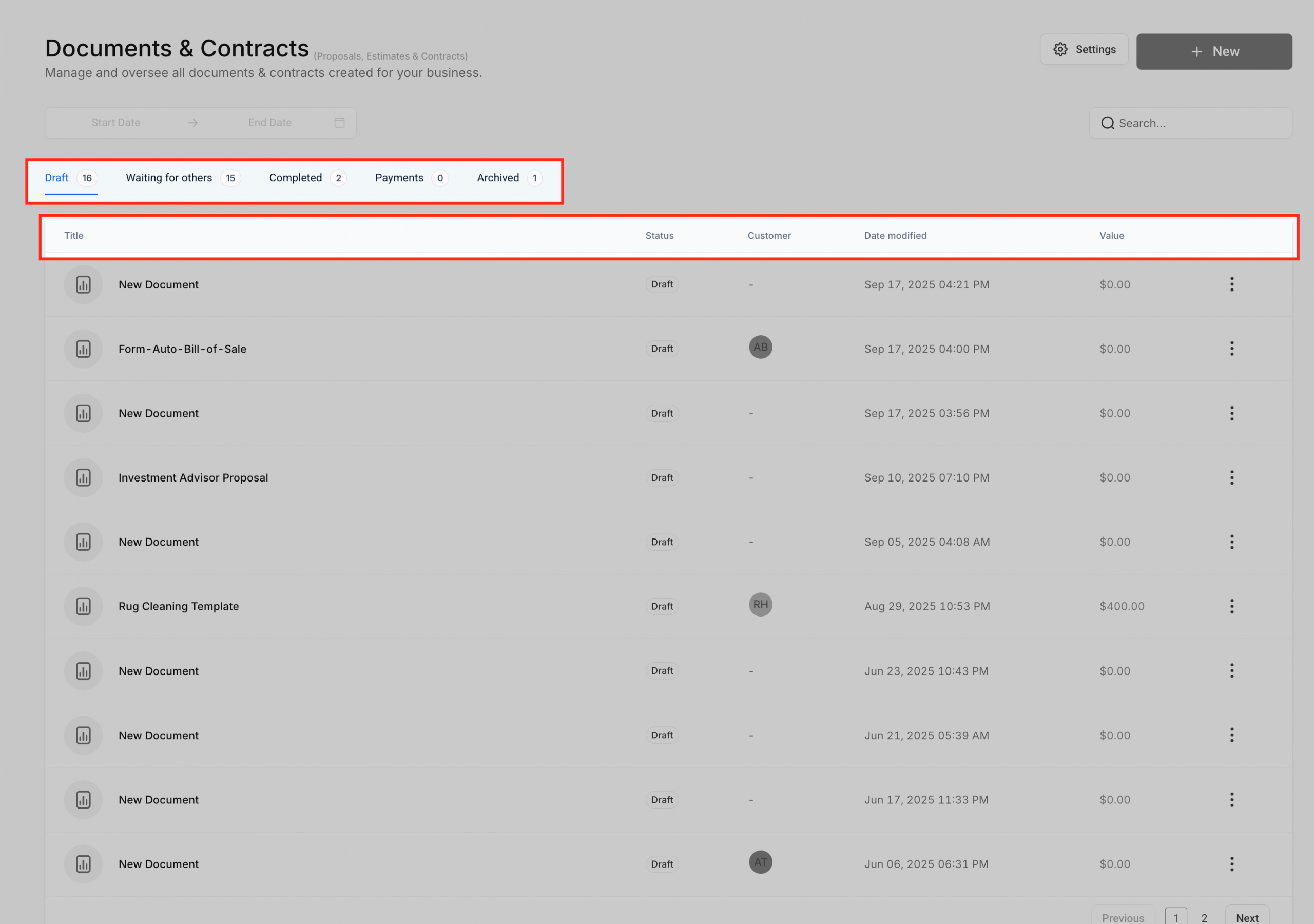
- The dashboard organises your contracts and proposals into tabs: Draft, Waiting for others, Completed, Payments and Archived. These tabs make it easy to track progress; for example, you can quickly see which clients still have to sign in the Waiting for others section.
- Every document row shows important details including Title, Status, Client, Date modified and Value. This lets you quickly assess which agreements are active, which need a follow-up and which are completed or archived.
- A three-dot menu next to each record provides quick actions such as View, Clone, Mark as completed, Download PDF, Convert to template, Share via link, Move to draft or Mark as rejected.
Creating new documents
You can create documents in three ways, depending on your needs.
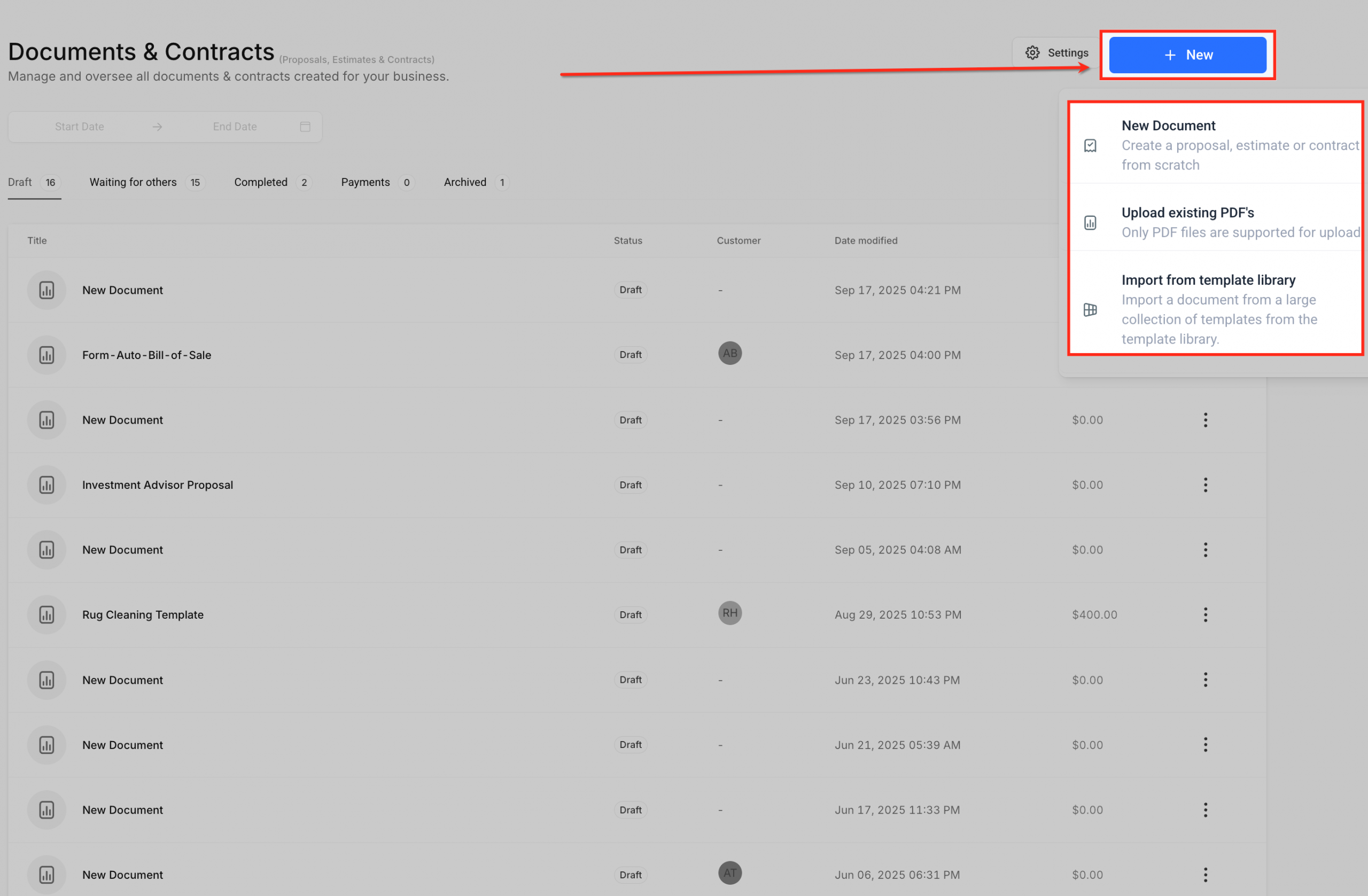
Click the + New button at the top right of the dashboard. Choose from:
- New document: start from scratch using the editor. For example, create a new proposal with text blocks, pricing tables and embedded videos.
- Upload existing PDF: import a PDF and overlay signature or text fields. For example, a coaching contract uploaded for the client's electronic signature.
- Import from template library: choose from your existing templates. For example, a cleaning company reuses its standard service contract.
The document editor toolbar
The editor gives you a flexible drag-and-drop environment to design, configure and finalise your documents.
Add elements
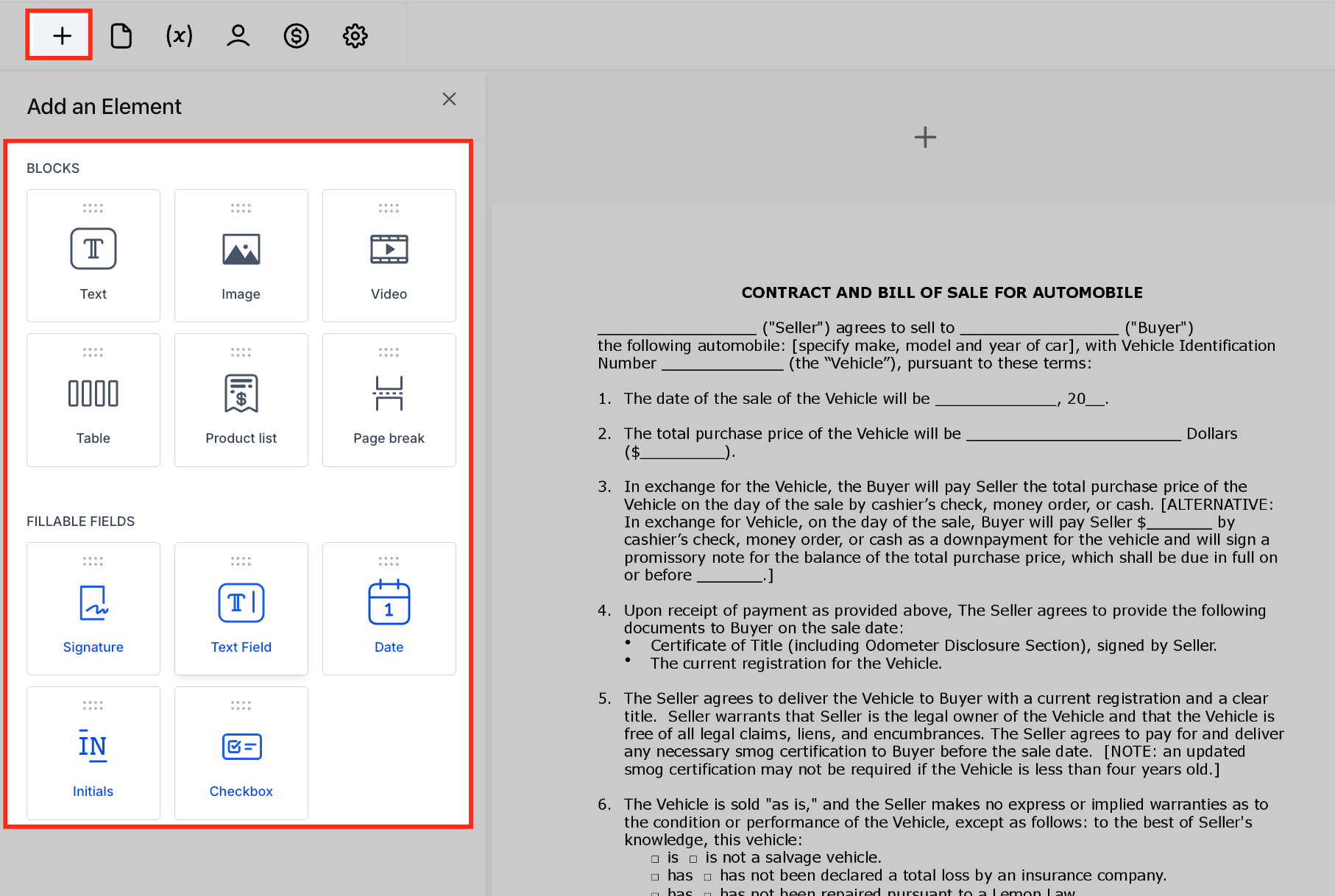
- Add text, images, videos, tables, product lists and page breaks.
- Insert fillable fields such as Signature, Text field, Date, Initials and Checkbox.
- After adding a fillable field (e.g. Signature), select it and use the Properties panel on the right. Use To be signed by to assign the field to the correct signer, including a specific staff member in your account.
Page management
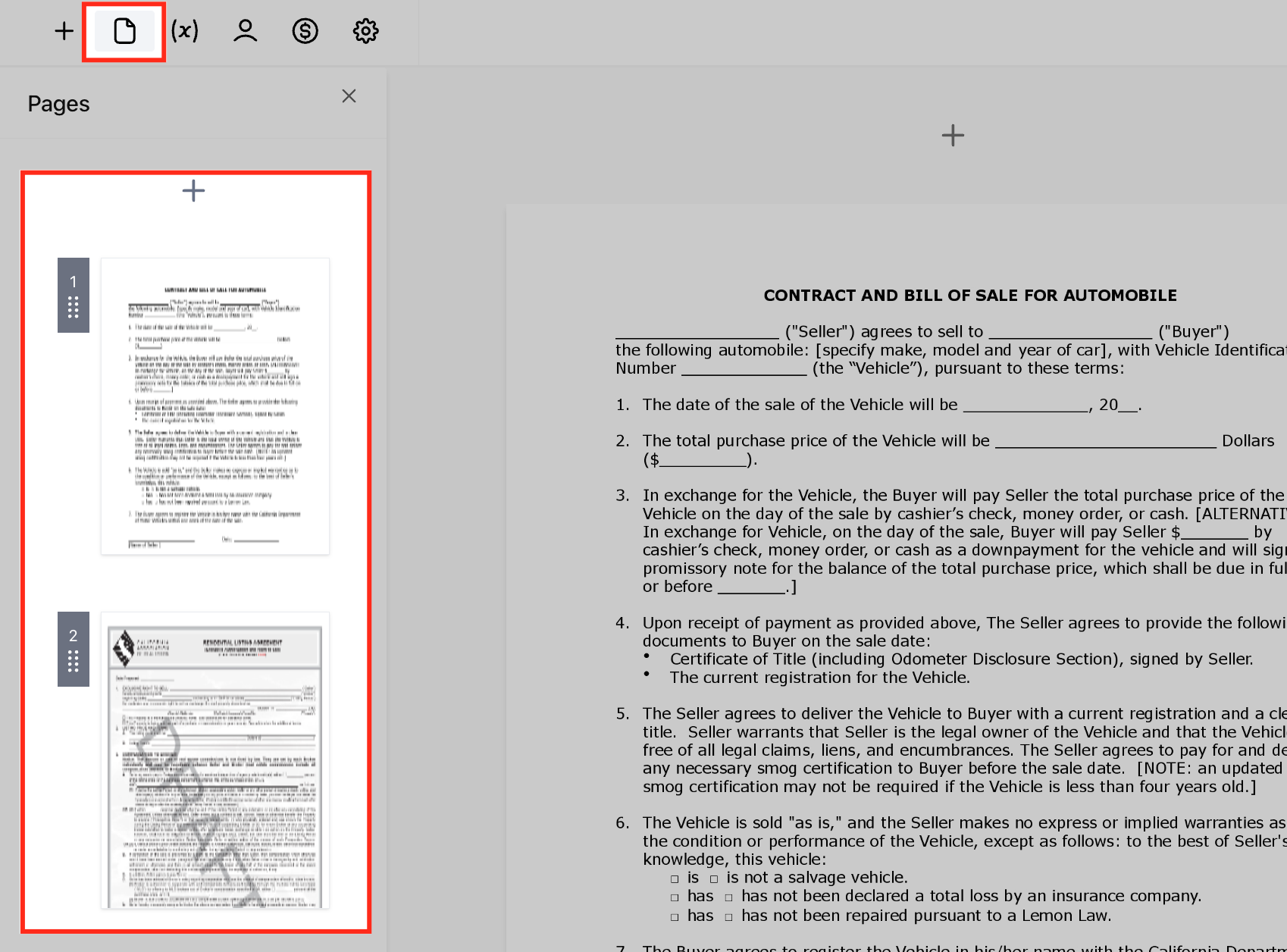
- Manage multi-page documents.
- Add, duplicate or remove pages as needed.
Document variables
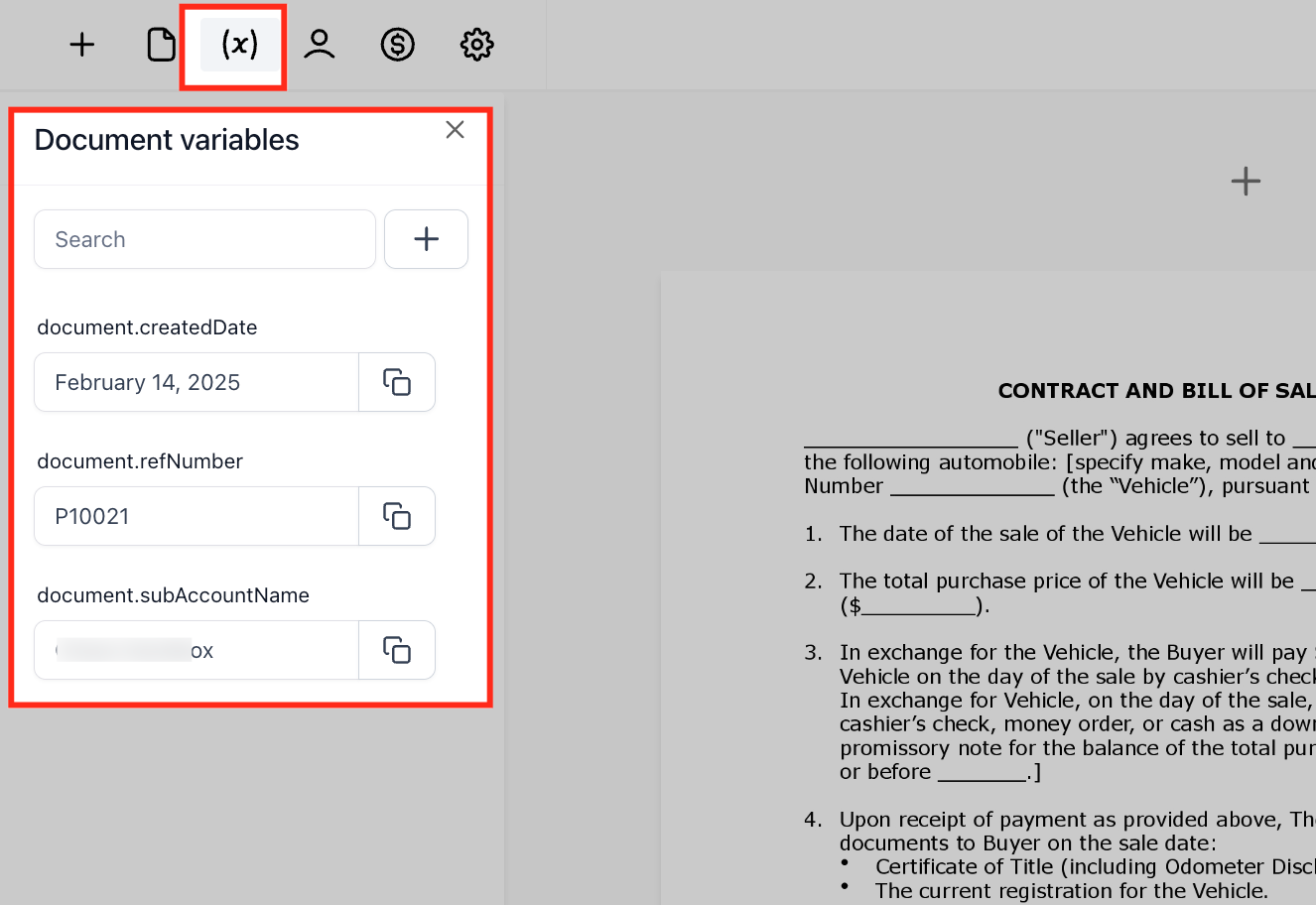
- Insert dynamic placeholders such as Creation date, Reference number, Account name and custom fields.
- Variables populate automatically with the correct data when the document is sent.
Content library
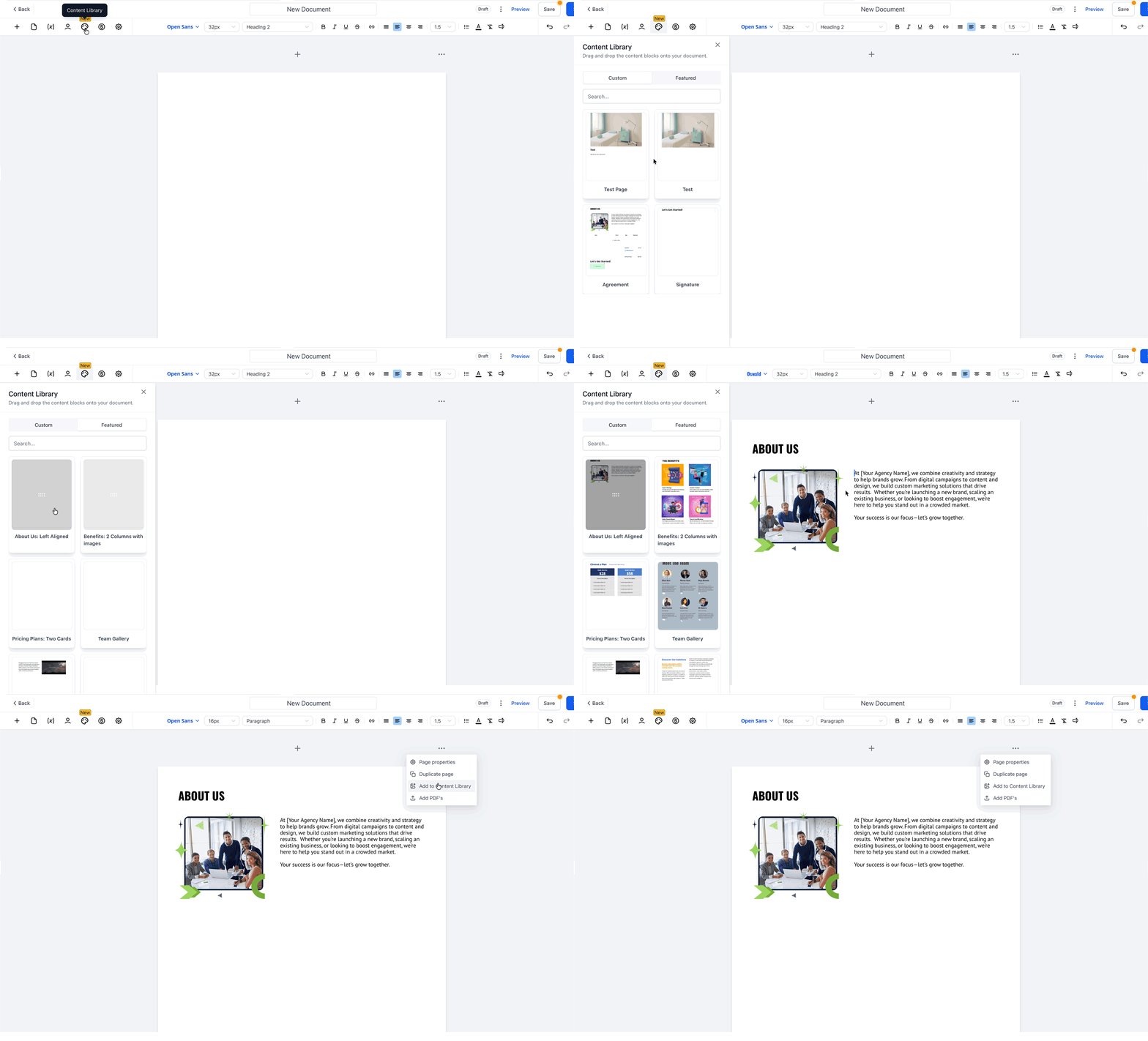
- A centralised library of reusable blocks and whole pages for documents and contracts.
- Save a section or page you will reuse via Add to content library and give it a name so you can find it easily.
- Insert saved items into any document or template from Content library → Custom using drag-and-drop.
- Update or customise the inserted content as needed once you have added it to the document.
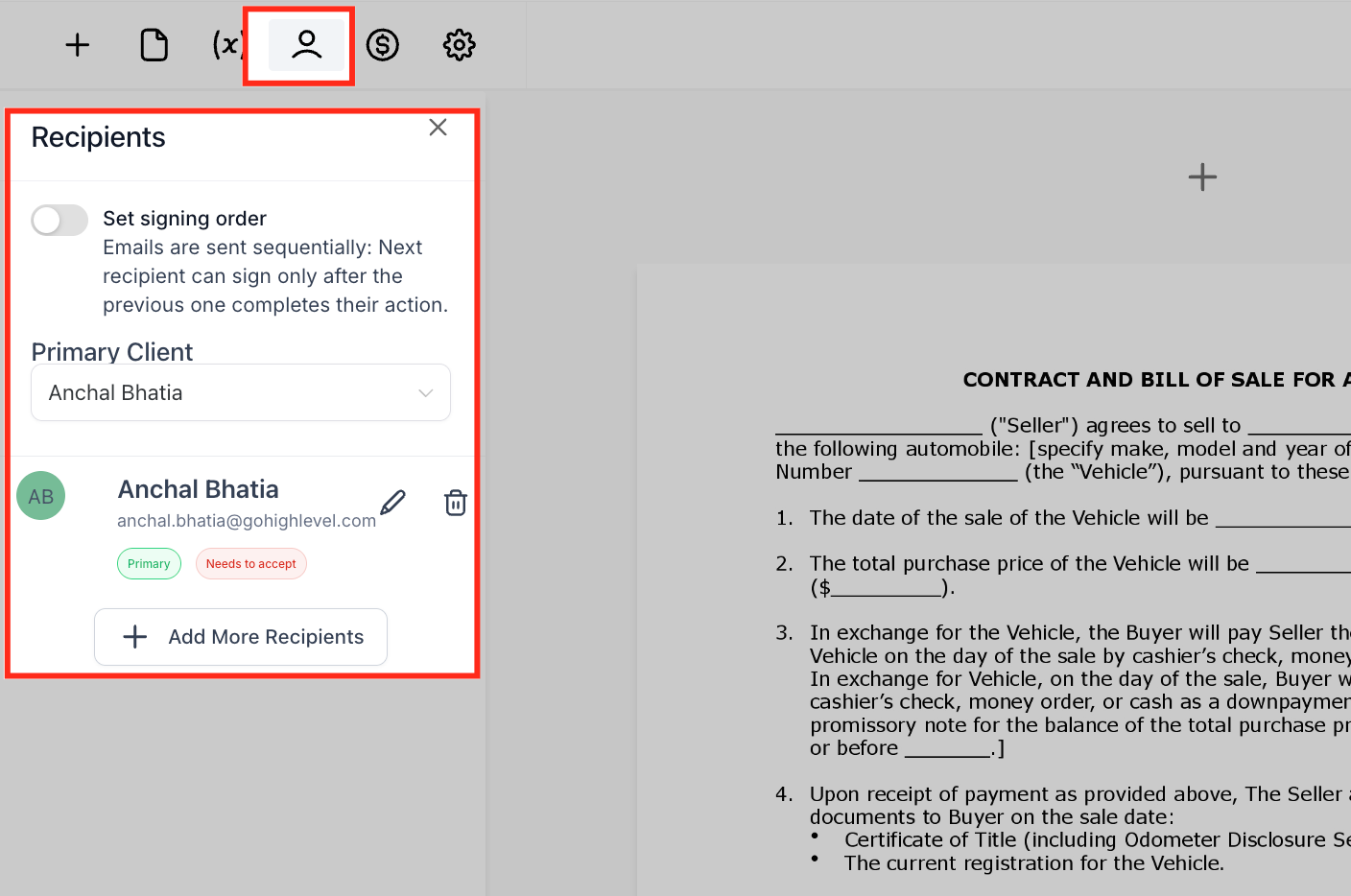
Recipients
- Define who has to sign or receive the document.
- Add several recipients and set the signing order (sequential or simultaneous).
- Each recipient is assigned specific fields (e.g. signature, initials).
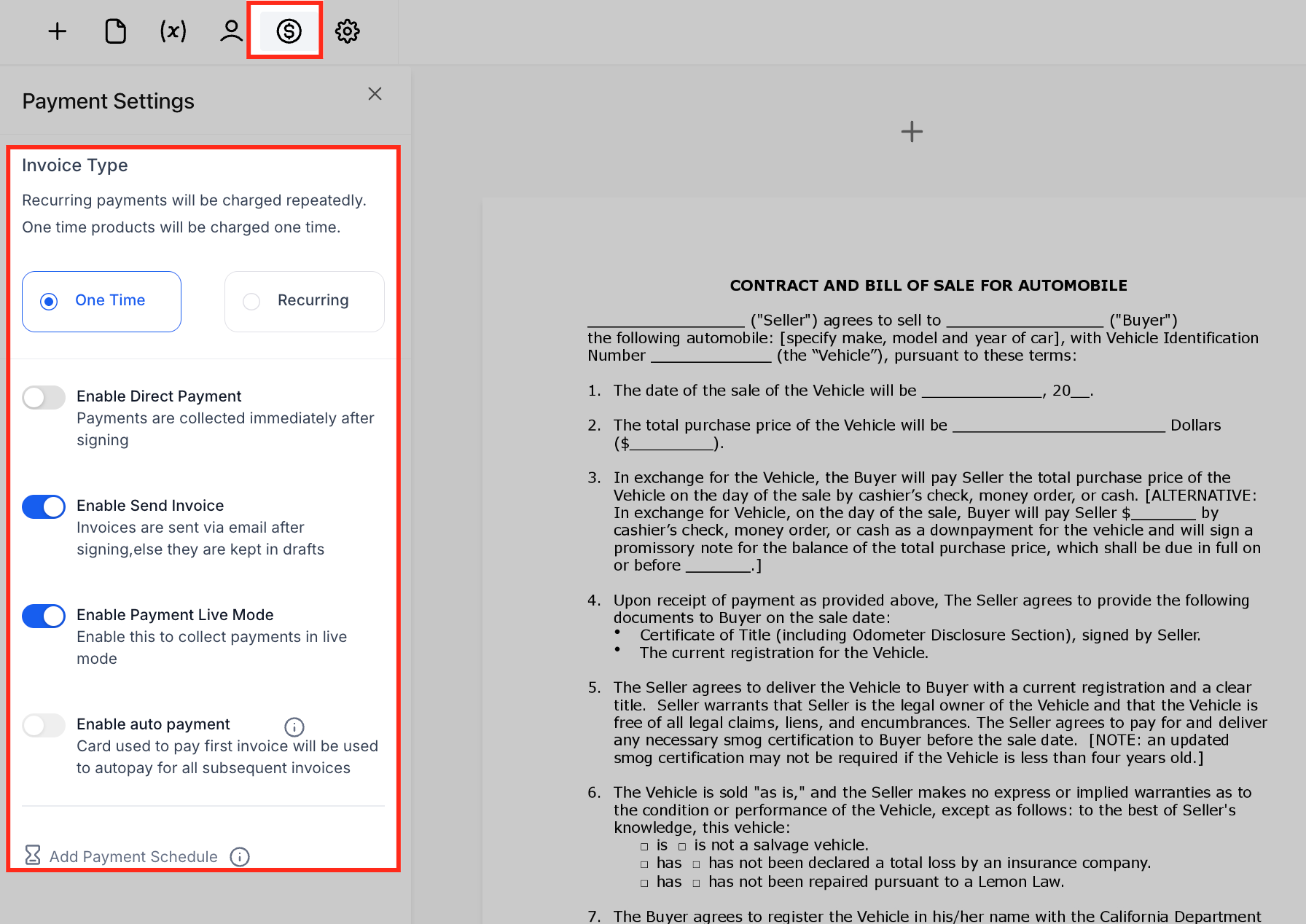
Payment settings
- Add payment options directly inside the contract.
- Choose between One-off or Recurring billing.
- Enable direct payment at the moment of signing or send invoices automatically.
- Supports live payment mode and automatic payment configurations.
Edit the email and choose a template
Choosing a template and editing the email just before sending makes sure the recipient sees the most accurate message. This reduces errors and speeds up client approvals.
What you can do
- Choose a template: use the Email template drop-down menu to select the version that suits the context.
- Edit before sending: the Edit icon is always visible, making last-second changes easy.
Steps
- Click Send on the document to open the sending window.
- Select the Email template you want to use.
- Click Edit to adjust the subject line or the body of the email if needed.
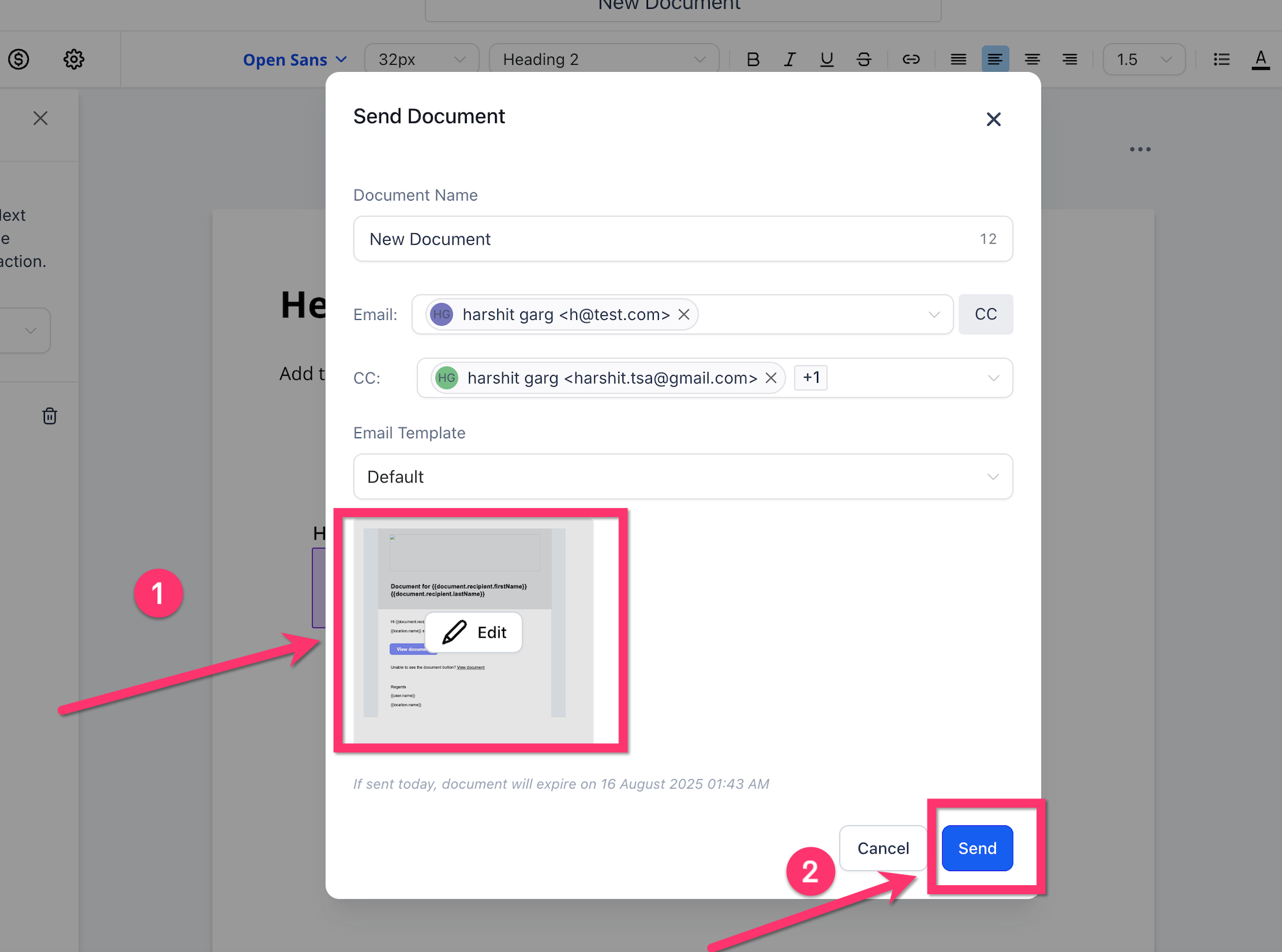
- Confirm the preview and send.
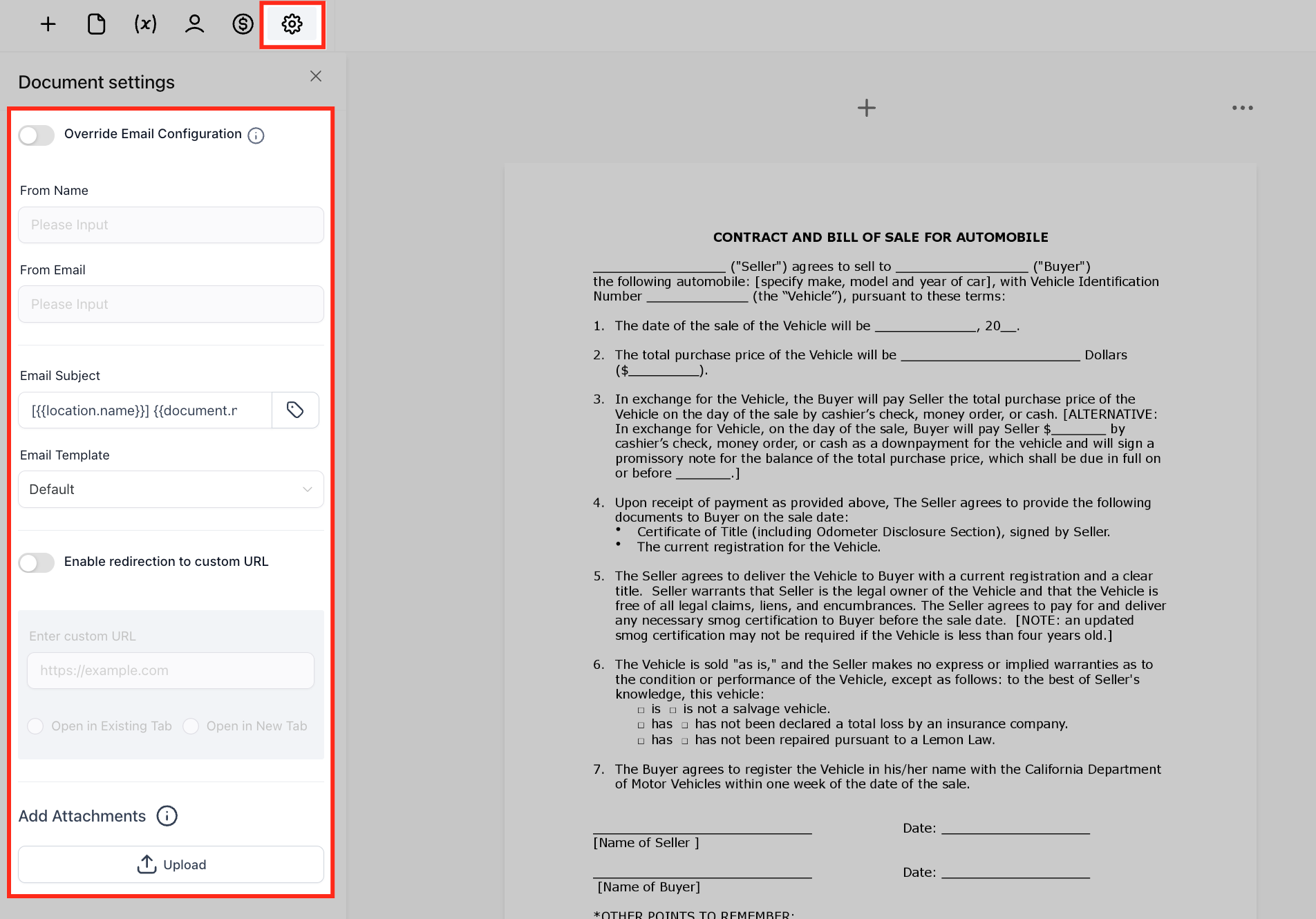
Document settings
- Control how the document is delivered.
- Override the default email configuration (Sender name, Sender email, Subject, Template).
- Redirect clients to a custom URL after signing.
- Upload attachments to include in the document email.
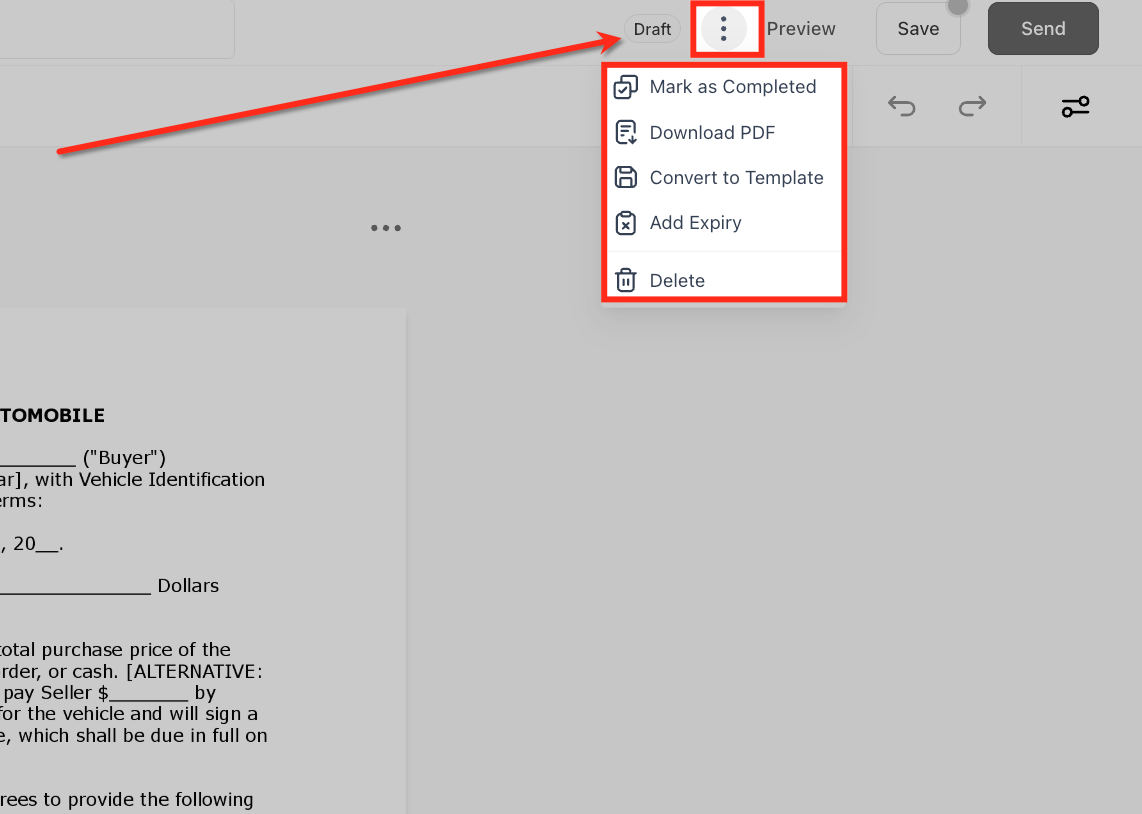
The actions menu inside the editor
- Open the three-dot menu (⋮) for additional options: Mark as completed, Download PDF, Convert to template, Add expiry date, Delete.
Sending options
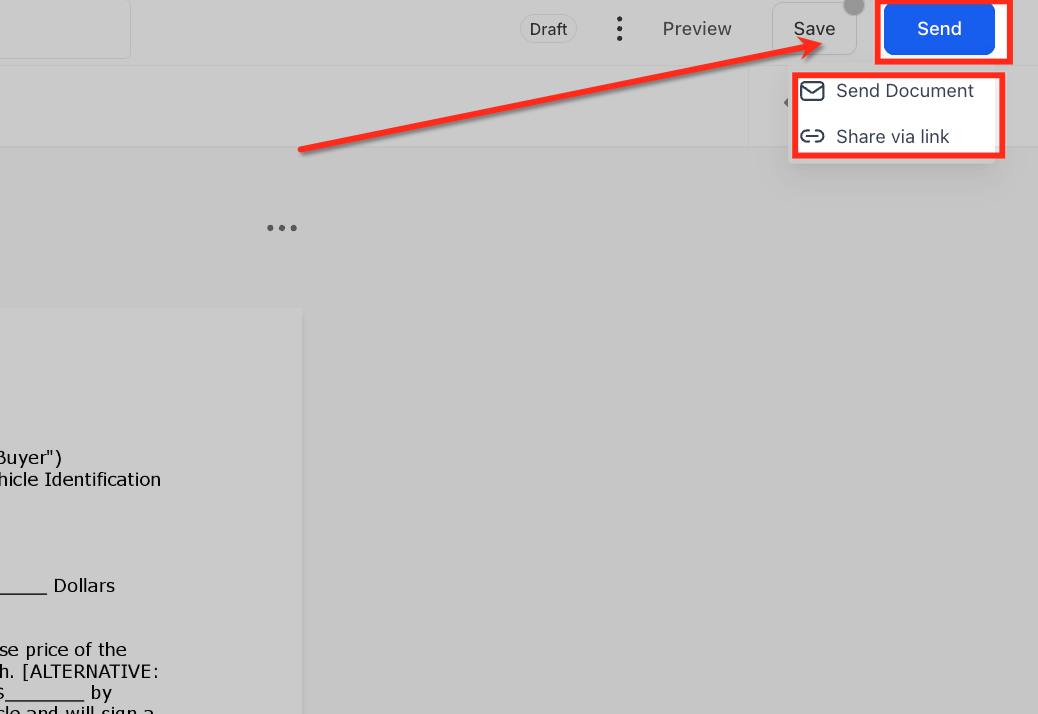
- Once the document is complete, click Send to deliver it.
- Choose between Send via email or Share via link.
Frequently asked questions
What happens if a client signs partially but does not complete the document?
If several signers are assigned and only some of them complete their fields, the document stays in the Waiting for others status. You can send a reminder to the missing signers by resending the document from the dashboard. The document will not move to Completed until every required signer has finished.
How secure are the electronic signatures and payment details inside documents?
Futuria CRM applies SSL encryption to all documents and payment data. Every signature generates a certificate with the IP address, email and date/time. Payment information is processed securely through your integrated payment provider and is never stored in Futuria CRM.
Can I create conditional content in documents (for example, showing different pricing tables depending on the client)?
At present, conditional logic inside documents is not supported. Each document is static once created. If you need variations, create several templates or use workflows to send different templates based on certain conditions.
What happens if I edit a template after sending a document?
Editing a template does not affect documents that have already been sent. Any change will apply only to future documents created from that template. This guarantees the legal integrity of agreements that have already been signed or are pending.
Can I accept several payment methods in a single document?
Yes, you can configure documents to accept several payment processors (e.g. Stripe, PayPal) if those gateways are connected to your account. Recipients can choose their preferred method at the point of payment.
How do expiry dates work with documents?
You can add an expiry date from the document actions menu. Once the date has passed, the document automatically moves to Expired and can no longer be signed. This is useful for time-limited offers or proposals.
Can workflows be triggered based on the use of a specific template?
Yes, workflows can filter both by Document status and by Template name. For example, you could send a reminder only when a specific "Service contract" template stays unsigned for more than 3 days.